Irish CGT & ETF Exit Tax
See what you owe Revenue
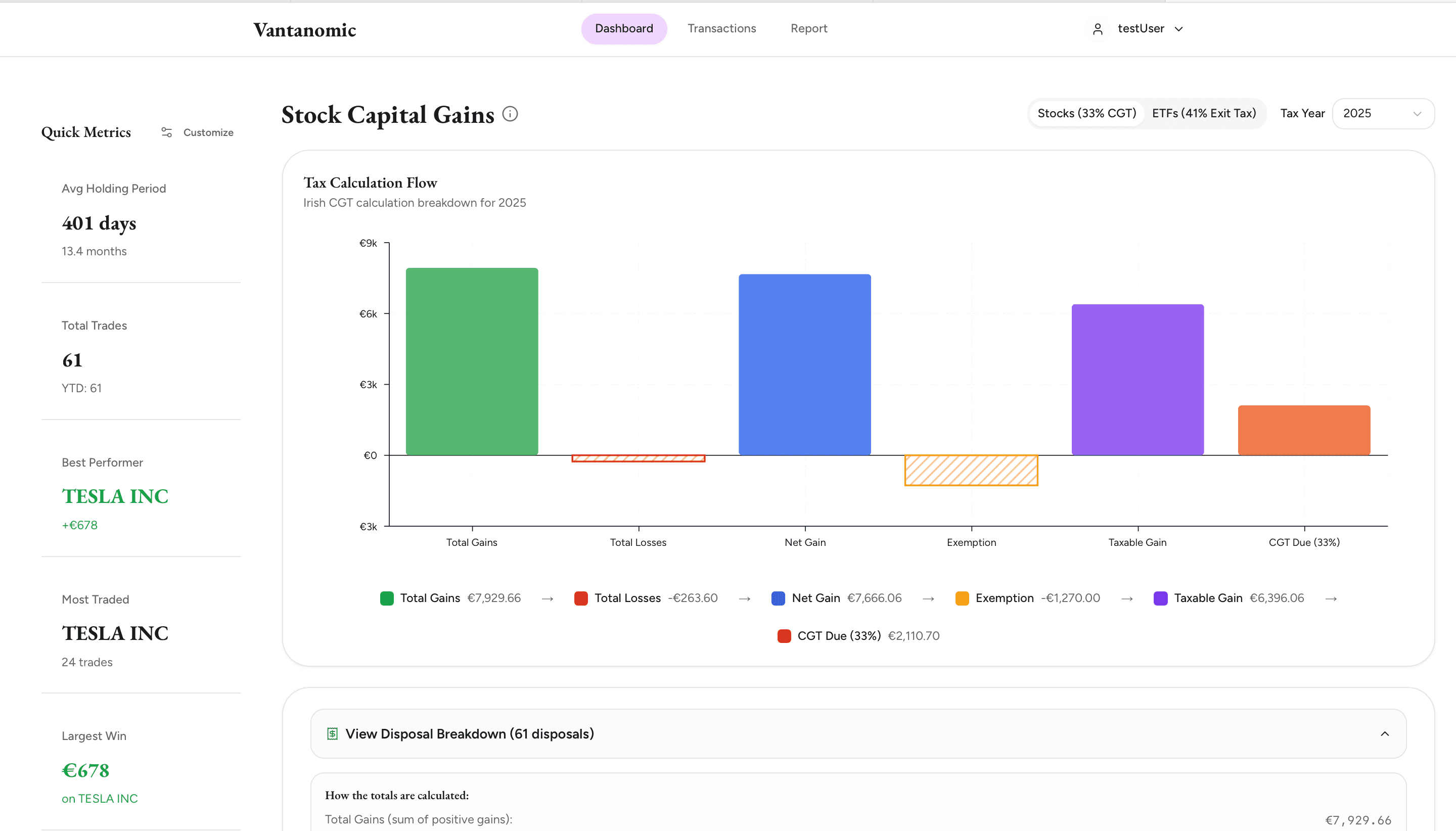
Vantanomic matches every disposal under FIFO — 33% Capital Gains Tax on stocks, Exit Tax on Irish and EU ETFs — and gives you the figures your CG1 and Form 11 actually need.
First in, first out — the oldest purchase is the one that leaves.
Broker-specific CSV adapters. Other files can be mapped manually, but mapping alone does not make an unsupported broker export filing-ready.
The rules
The numbers Irish Revenue applies
Two regimes, two rates, two forms. Getting the wrong one is the most common mistake Irish investors make.
33%
CGT on stocks and confirmed CGT-treated products
38%
Exit Tax on Irish and EU ETFs — 41% for 2025 and earlier disposals
€1,270
Annual CGT exemption, per person
15 Dec
Payment deadline for Jan–Nov disposals
Benefits
Built for the way Irish tax actually works
Most portfolio trackers are built for US brokerage accounts and bolt tax on afterwards. This starts from Revenue's rules.
FIFO, the way Revenue requires
Every sale is matched against your oldest matching purchase, lot by lot, with fees folded into cost basis on the way in and out of proceeds on the way out.
Fund treatment is evidenced
An ISIN helps identify a product, but it does not settle its Irish tax treatment. We require a confirmed fund classification before calculating Exit Tax or CGT, and apply the rate for the relevant chargeable event.
Losses handled correctly
Stock losses offset gains and carry forward indefinitely. ETF losses under Exit Tax do not — and we keep the two pools apart so you never claim relief you are not owed.
Export what the forms need
Annual summaries and per-disposal breakdowns laid out for CG1 and Form 11, so filling in the return is transcription rather than arithmetic.
Your data stays yours
Transactions are stored against your account alone, protected by row-level security. No broker credentials, no read access to your account — just a CSV you choose to upload.
How it works
Four steps, about five minutes
No account linking, no read access to your brokerage. One file in, your tax position out.
01
Upload your CSV
Export from your broker and drop the file in. The format is detected and columns are mapped for you.
02
Confirm the mapping
Check the parsed rows before anything is saved. Adjust any column we guessed wrong — once.
03
FIFO runs
Disposals are matched against lots chronologically, split by asset type, with the correct rate and exemption applied to each.
04
Export your figures
Year summaries and disposal detail, ready to transcribe onto your CG1 or Form 11.
Deadlines
Irish tax dates worth having in your calendar
CGT is paid in two periods, and the return that declares it is due long after the payment. Missing either is where interest starts accruing.
Two payment periods, one return
You pay long before you file
Questions
Irish CGT and Exit Tax, explained
The rules that catch people out most often, answered plainly.
What is Capital Gains Tax (CGT) in Ireland?
Capital Gains Tax is a tax on the profit (gain) you make when you sell or dispose of an asset that has increased in value. In Ireland, the standard CGT rate is 33% on gains from shares, stocks, and most investments. Irish residents must report gains to Revenue and may need to file a CG1 form with their annual tax return.
What is the current CGT rate in Ireland?
The current Capital Gains Tax rate in Ireland is 33% for most assets including stocks, shares, and property. This rate applies after you deduct the annual exemption of €1,270 per person. ETFs domiciled in Ireland or the EU are subject to Exit Tax instead: 38% for disposals on or after 1 January 2026, and 41% for disposals up to 31 December 2025.
What is the annual CGT exemption in Ireland?
Each individual in Ireland has an annual CGT exemption of €1,270. This means you only pay CGT on gains above this threshold. The exemption applies per person, per tax year. Note: This exemption does NOT apply to Exit Tax on Irish/EU domiciled ETFs.
What is Exit Tax and how does it differ from CGT?
Exit Tax can apply to Irish funds and offshore funds that meet the relevant statutory conditions. The rate is 38% for disposals on or after 1 January 2026 and 41% for disposals up to 31 December 2025 — it is the date you sold that decides the rate, not the date you file. Unlike CGT, Exit Tax has no annual exemption and losses cannot offset gains. An ETF’s exchange or ISIN country is not enough to decide its Irish tax treatment: confirm the legal product and fund classification before filing.
What is the FIFO method for calculating CGT?
For shares of the same class acquired on different dates, Revenue’s share rules generally identify the oldest shares first, subject to the special four-week rules. This share-identification rule is not automatically a rule for every asset class, including crypto-assets.
When are CGT payment deadlines in Ireland?
Irish CGT has two payment periods: gains from January to November are due by December 15th of the same year (Period 1), and gains from December are due by January 31st of the following year (Period 2). The CG1 form must be submitted with your annual tax return by October 31st (or mid-November if filing online). See our complete guide to CGT deadlines for more details.
What is the four-week rule for Irish CGT?
The four-week rule (also called the "bed and breakfasting" rule) is in section 581 TCA 1997. If you sell shares at a loss and buy back shares of the same class within four weeks, the loss is NOT disallowed — it is ring-fenced. It can only be set against a gain on a later disposal of those repurchased shares, rather than against your other gains. A separate part of the same section reverses FIFO where shares are sold within four weeks of being bought.
Can I offset losses against gains for CGT?
Yes, for CGT on stocks and shares, you can offset capital losses against capital gains in the same year, or carry forward unused losses to future years. However, losses from assets subject to Exit Tax (Irish/EU ETFs) cannot offset gains from other assets.
What is the CG1 form?
The CG1 form is the Irish Revenue form used to declare capital gains and losses from stocks and shares. You must include it with your annual tax return if you made taxable disposals during the year. Vantanomic's export reports help you prepare the information needed for your CG1 form.
Do I need to file Form 11 for ETFs?
Yes. If you hold Irish or EU-domiciled ETFs subject to Exit Tax (41% for 2025 disposals, 38% from 2026), you must file a Form 11 (self-assessment tax return) to declare your gains—even if you have no other self-employment income. The CG1 form alone is not sufficient for Exit Tax. Form 11 is filed through ROS (Revenue Online Service) by October 31st, or mid-November if paying and filing online.
What brokers does Vantanomic support?
Vantanomic currently has broker-specific CSV adapters for DEGIRO and Trading 212. Interactive Brokers and other files can be mapped manually, but a successful mapping is not proof that an unsupported broker export is filing-ready; review the reconciliation result before relying on it. Revolut’s current export is not yet a supported automatic adapter.
Is Vantanomic free to use?
Yes. Importing your transactions, running the FIFO calculation, tracking your portfolio and exporting your reports are all free today, with no card required. We provide estimates only—please consult a tax professional for official tax advice.
Ready to know what you owe?
Import your trades and see your CGT and Exit Tax position in minutes. No card, no broker credentials.
Vantanomic provides estimates. It is not tax advice.